How does the idea of simulation or synthetic reality play into this body of work?
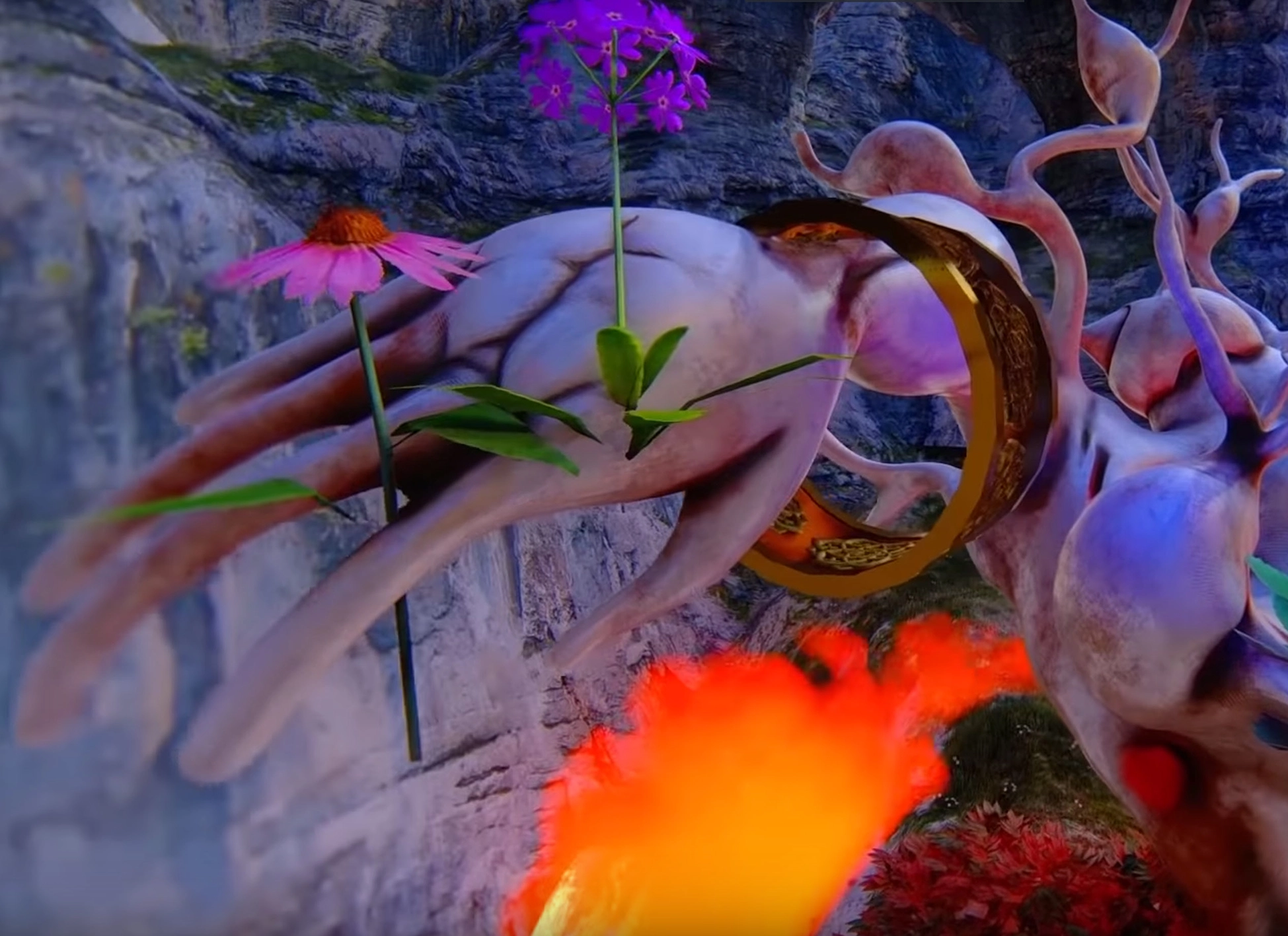
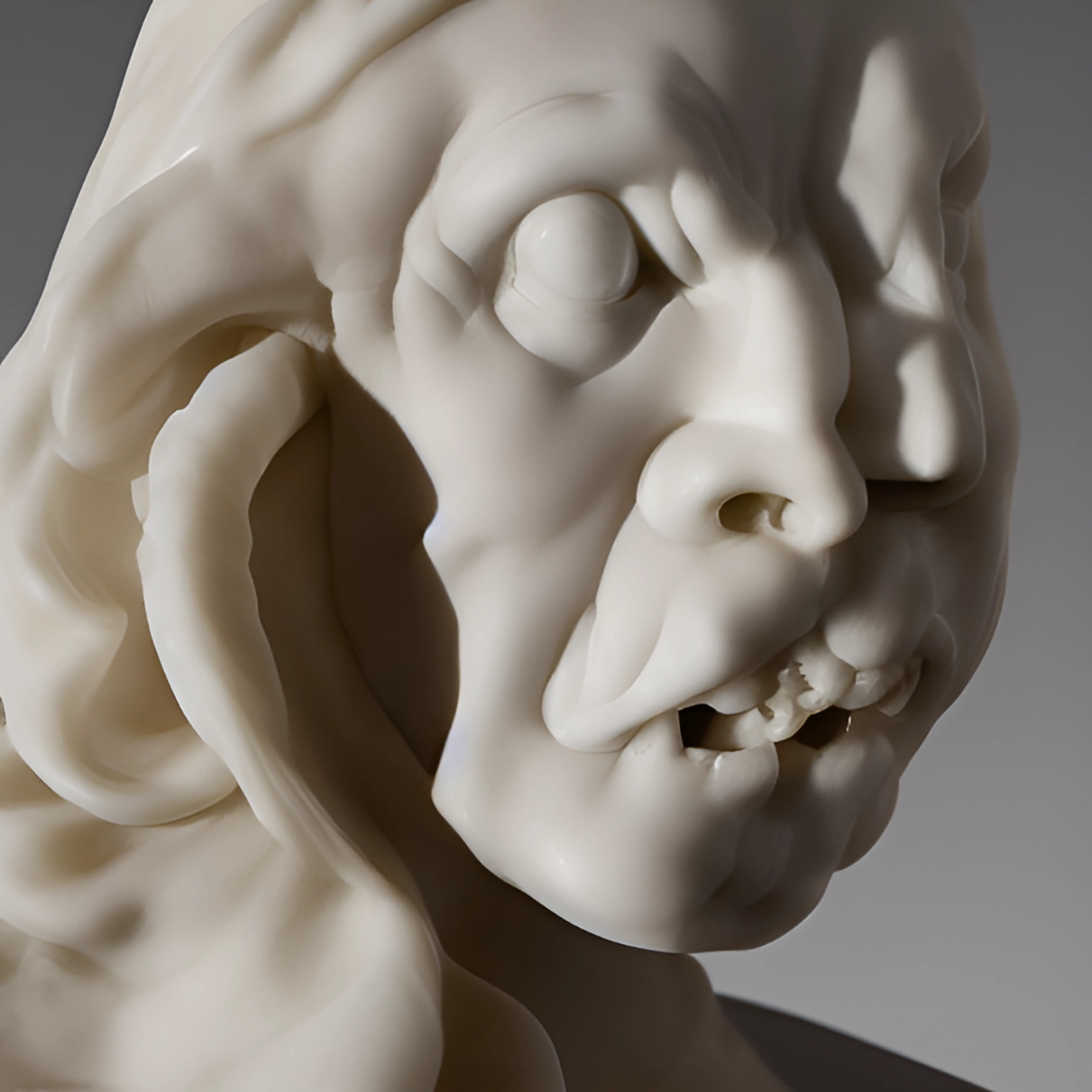
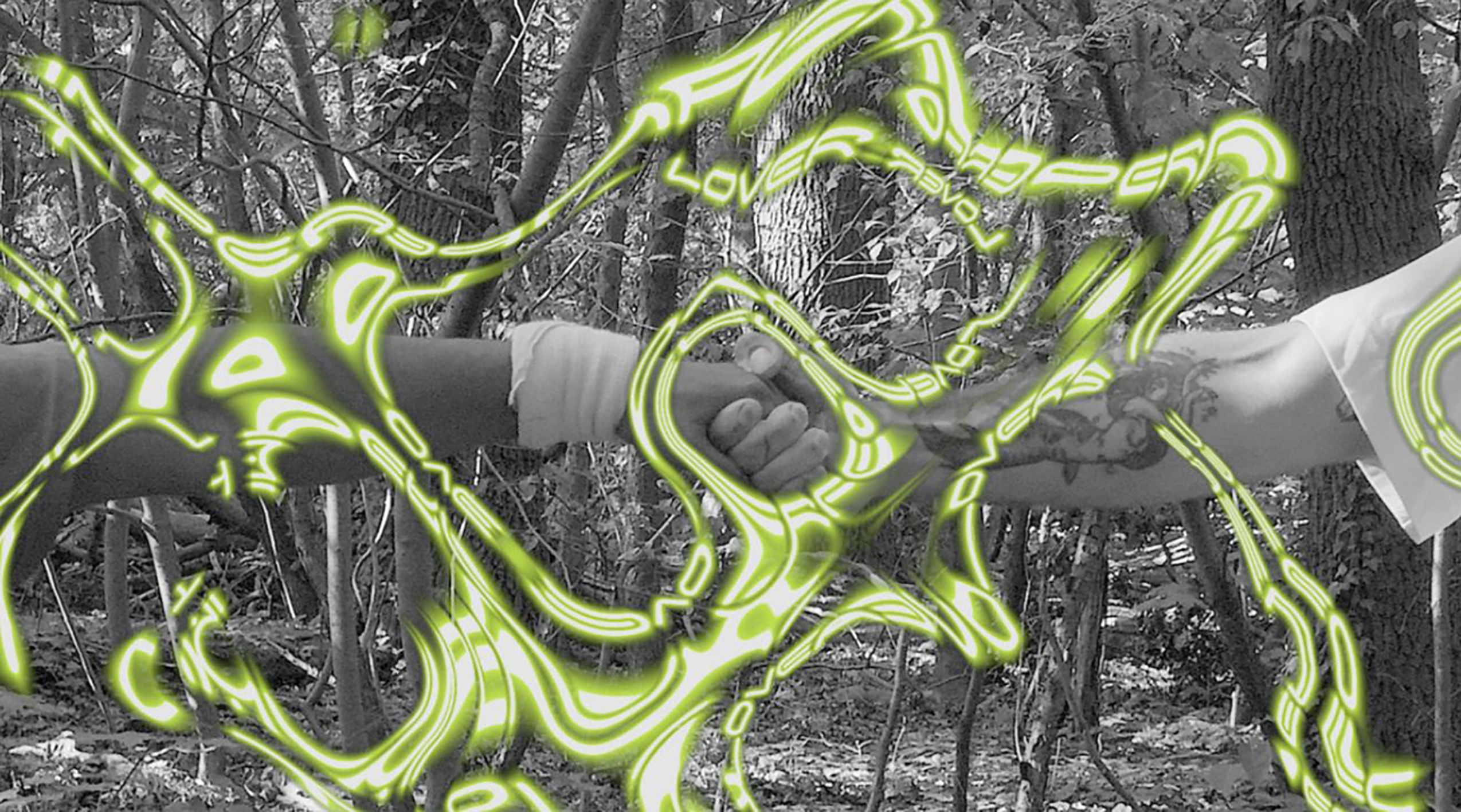
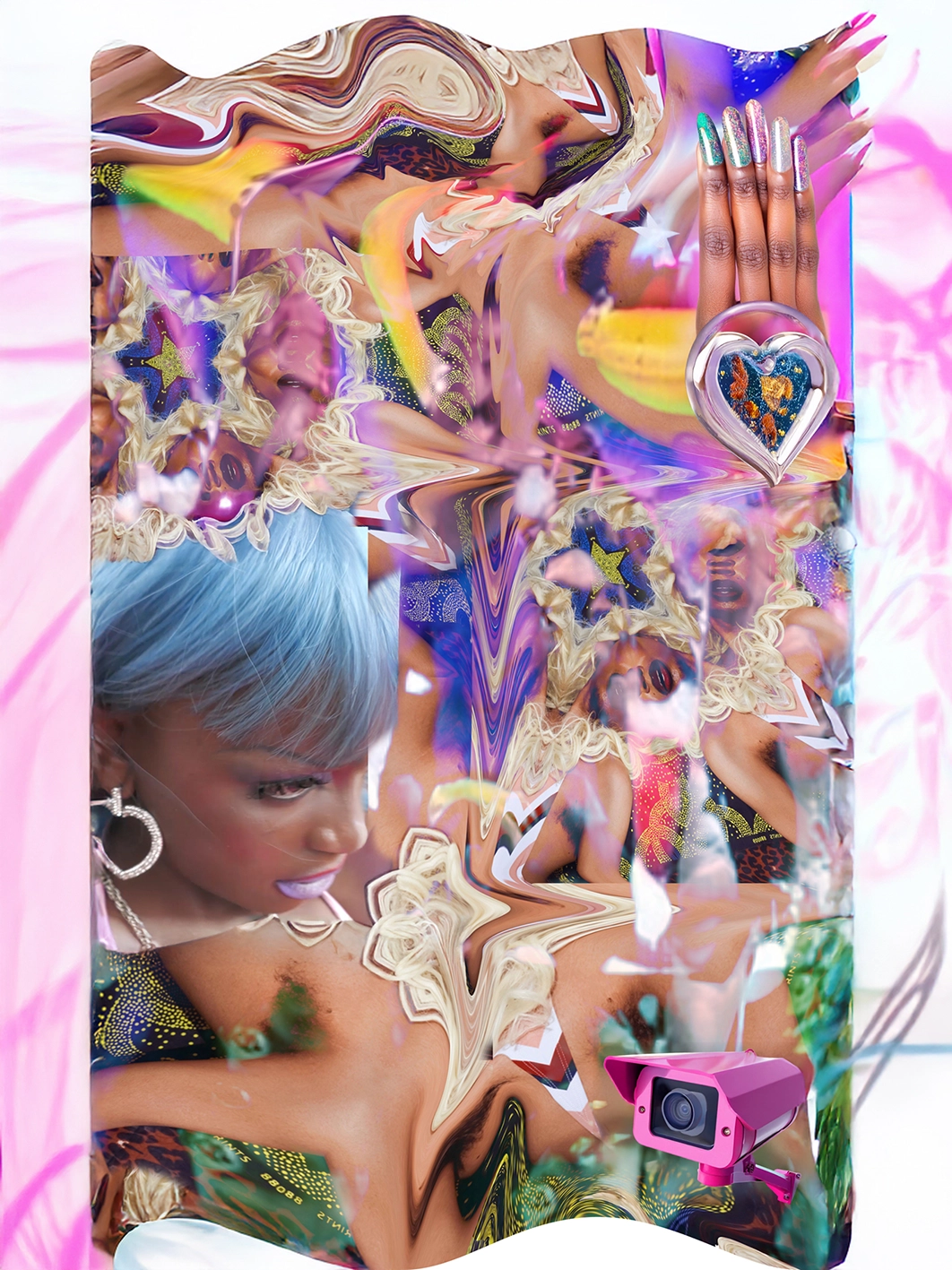
The idea of constructed, synthetic reality is a state that traverses throughout most of my work in an emphatic way. Bodies, environments, landscapes, and objects always seem to be born or to be coming from eerie worlds and places that are not absolutely denying reality, but they are embedding it and filtering it through a lens that allows distortion, the unexpected, and weirdness to become part of them. Accordingly, in this work we witness a body or many bodies merging into one another as they seem to be balancing between a natural and a constructed state. There is something uncanny but also familiar about this sculptural unified body; it seems that we are witnessing a suspended moment in time while the body transforms. It extends its limbs or branches—it is still unclear if this body is shapeshifting or if it stands there frozen, discovered by a ‘hovering eye’ that is observing it.
What does time feel like in this piece?
Time in this piece feels like an instant pause, or a glimpse at a moment of uncanny stillness. We can see a body or many bodies, a plant or many plants, tangled; we see something resembling a hand extended towards us, flowers growing from it—but behind it there is more to be revealed. It is like a moment petrified. The scene also seems to be describing a ‘before’ and an ‘after’; it implies some kind of motion as it contains an intense corporeality and a peculiar ecstatic feeling about something that happened or is about to happen. So at the same time, I can say that a feeling of expectation, wondering, or anticipation is definitely present, as we are witnessing this in-between state.
Can you describe the emotional tone of this edition— is it utopian, anxious, intimate?
This particular edition evokes a feeling that is balancing among different states. We are witnessing a fleeting moment of a body or of bodies that stand almost frozen in time; it feels that they are in a pause. We can feel their limbs blending; it feels that we see one body shapeshifting or many bodies that are merging into one—being in a state of blooming or weird entanglement, moving out of oneself and becoming a new choreographed unity. At the same time, the peculiar materiality that this sculptural body has makes us wonder about its origins and its ontology. This edition approaches the idea of cosmic bodies as per Anaïs Duplan, organisms that can be vast and contain many materialities. So in a way, I feel that the image evokes a feeling of bodies in motion but also bodies standing still as they become a new organism. It is utopian but at the same time uncanny and alienating; it feels familiar but also uncomfortable.
Were there particular visual or sound references guiding this work?
This image is part of the world that I built for a video I created for the band Acid Baby Jesus. The song I created the video for is called ‘Faces of Janus,’ and certainly it served as an inspiration. Lots of mythological elements are embedded in this work because Janus is considered to be an ancient god of transition and new beginnings. He is depicted always with two faces, one looking to the past and one towards the future, so this liminality is quite present in this work. Also, the dreamy, uncanny lyrics of the song were very important in order to set and build the ambience and materiality of the visual elements as well.
How do you imagine the future of bodies in relation to technology and the environment?
In my work, I often explore speculative worlds and materialities where bodies are fluid, in limbo, shimmering, mutating, or dissolving. My entities are balancing between technological and natural ecosystems. These visions aren’t purely utopian or dystopian; they’re ambivalent, exploring both the potential and the fragility of these hybrid states. I imagine the future of bodies as a kind of uncanny choreography between technology and environment—a continuous negotiation and confrontation between adaptation, transformation, and peculiar intimacy. I like to think that entities—as my work also suggests very often—will be able to have a certain kind of adaptability and sensitivity that allows them to ‘expand’ or ‘shrink,’ to be porous, to be able to reshape and embed within them systems and mechanisms that challenge any fixed identity and control.
Can you speak about your process— do the visuals come before the concept, or vice versa?
Often, when I am describing my process, I feel like a conductor that tries to direct and keep the balance and harmony among many diverse elements. The beginning of my process can be an image, a sound, a small phrase, or note that I will write down on my phone or something that I will observe. There is, of course, a core idea and concept that I have in my mind, and then I try to build meanings, characters, landscapes, and soundscapes around this idea. I am directing different types of worlds and protagonists, building piece by piece, rhythmically, their identities—or deconstructing them at the same time as I build them. My worlds sometimes are chaotic and fragmented; they evade linearity—everything happens at the same time, everything gets inevitably entangled.
What role does slowness or duration play in your time-based works?
Slowness and duration are essential elements to how I construct and direct my time-based works. Rhythm is a core element in my videos, and the state of slowness and a certain kind of lingering are very dominant. There is a contemplative, suspended feeling that derives from the way that the camera moves or the way that the creatures, natural and synthetic bodies, shapeshift and transform themselves. In my videos and simulations, movement at times tends to unfold gradually, allowing forms, textures, and environments to reveal themselves in layers. This type of rhythm becomes a way to heighten attention, to encourage a kind of attunement to subtle shifts—in light, sound, or materiality. There are moments, though, that this slowness and calmness get interrupted by frantic motion that almost becomes uncomfortable for the viewer; it feels like things are breaking down, creatures become ecstatic, motion becomes fragmented and repetitive. I like to think of my time-based works as bodies that live on their own, organisms that can at times pause and exhale or breathe loudly and fast, almost like releasing a ‘roar.’
At the same time, duration allows for these kinds of transformations. The digital environments I create, like the creatures that reside within them, are often in states of becoming—morphing, melting, or regenerating. Duration allows me to explore the elasticity of these processes: how bodies and landscapes evolve, how they might get born, breathe, or decay. In a way, it is also an acknowledgment that change, in all living and synthetic systems, happens through extended, interconnected rhythms. And a reminder also to experience time as a material that can be thick and textured, where transformation can exist in many layers and temporalities.
What kind of intimacy can exist in digitally constructed spaces?
Digitally constructed spaces are not just a simple mirror and reflection of our world and relationships; they are now actively shaping them and creating the conditions in which feelings of intimacy can definitely be birthed in different forms. A new kind of shared presence, vulnerability, and emotional exchange unfolds across screens, networks, and virtual environments. Users interact, create slang, and form communities that exist beyond the traditional forms—communities that are fluid, complex, and deeply affective. This kind of intimacy is just mediated differently. It can reveal new sensitivities, but it also shows us ways in which we relate to each other, to nonhuman entities, or to the environments we co-create. Digital intimacy is redefining and expanding our understanding of connection and is guiding us towards forms of belonging that aren’t bound by physical spaces or stable identities.
It is a form of queer, generative intimacy—one that embraces fragmentation, multiplicity, and opacity. What I truly find really important in this framework is that the digital becomes a site where alternative intimacies can occur: intimacies that are not only emotional or relational, but also political, fluid, and disembodied—it creates space for self-making, unmaking, and collective becoming.
Eva Papamargariti has a practice which spans moving image, printed matter, and sculptural installation. Her work explores the cognitive and affective relations between coexisting realities, focusing on the dynamic intra-connections and intra-actions that occur across these systems. The work often unfolds within suspended moments where the grotesque, fictional, and real converge, giving rise to hybrid and mutable worlds.
Papamargariti’s research and practice engage themes of identification, metamorphosis, simultaneity, and the merging of physical and virtual environments. Using video, text, sound, motion capture, AR, CG animation, 3D scanning, character-creation software, sculpture, and textiles, her projects investigate becoming, liminality, techno-romance, and the symbiotic relationships between human and non-human agents. These explorations trace the entanglements and kinships that emerge from continuous interaction with technological and machinic systems.
Her work also examines the processes shaped by online presence, including the construction and transformation of identity, the use of vernacular imagery and language, and the architectures of worldbuilding. Further attention is given to the marks inscribed upon objects and habitats through ongoing engagement with digital and material environments.
Papamargariti has exhibited in institutions, museums, and festivals including the New Museum, Whitney Museum, Tate Britain, MAAT, EMST, Museum of the Moving Image, MoMA PS1, GAMeC, Pioneer Works, Museum of Contemporary Art Montreal, The Bass, Athens Biennale, Mediterranean Biennale, Thessaloniki Biennale, MUTEK, and Transmediale. Residencies include the LUMA Foundation (2023), the New Now program at Zollverein (2023), Onassis AiR and Onassis ONX (2024-2025). Her work is held in public and private collections such as the Dakis Joannou Collection (DESTE Foundation), Onassis Foundation, PCAI Collection, and MOMus Collection.