What kind of visibility—or invisibility—are you exploring in this edition?
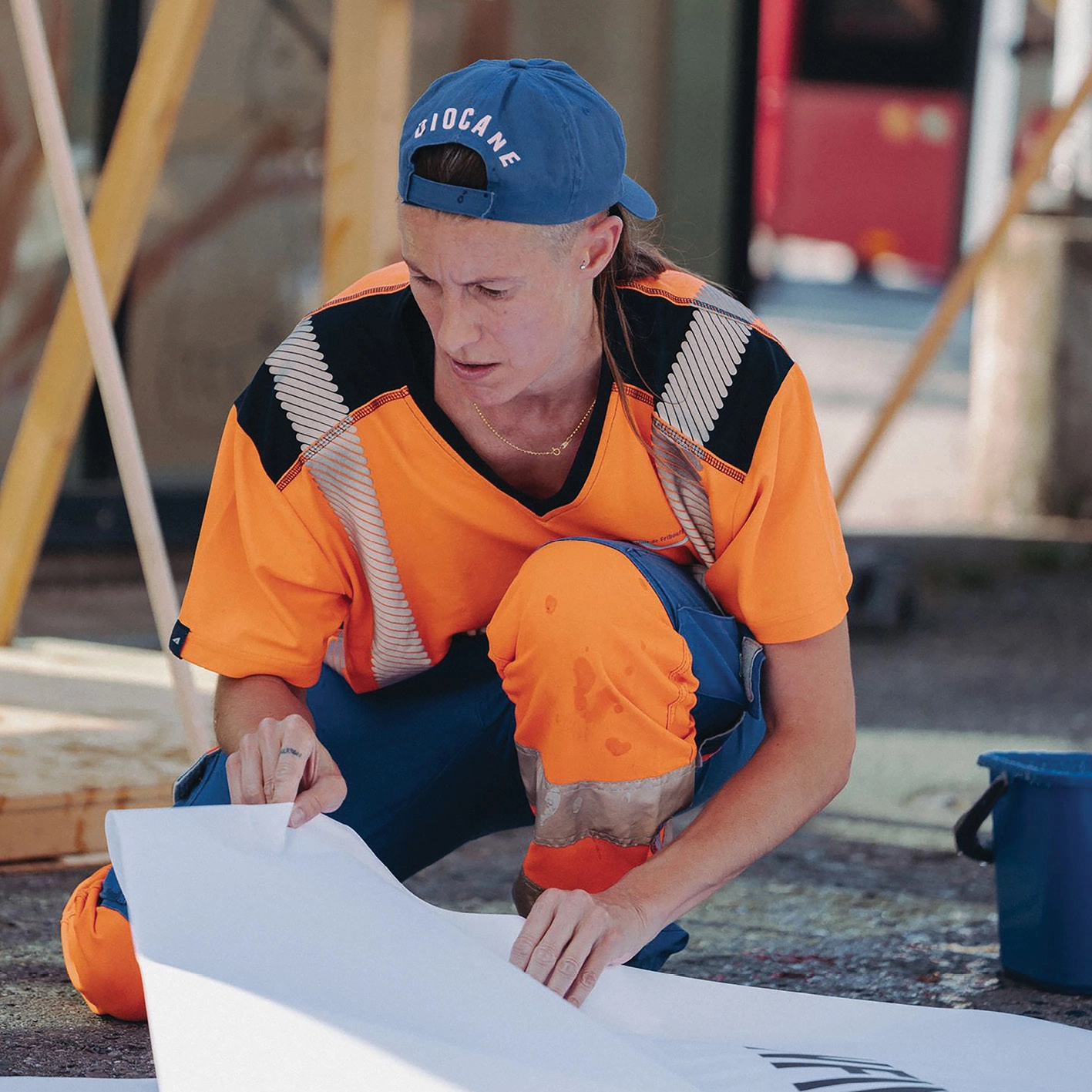
Questioning visibility and invisibility in public space because of privilege, it plays a game in my research. I started doing actions that were not authorized, and I was wearing an orange uniform as a device that allowed me to be mimetical in the urban landscape, because it is used by street workers in public space. Paradoxically, a hyper-visible orange suit gave me the power of a kind of invisibility, and I could convey political contents in my posters. Privilege gives invisibility in public space in terms of the dynamic of powers. When I do wild posts without authorization, the police care less about me compared to other bodies, because of my white privilege. At the same time, in terms of gender, I can experience the advantages of passing as a cis man in public spaces, because of how I’ve been perceived from the normative gaze. I can use the privilege of it on certain occasions, like walking at night or using “man” public toilets.
Do you think of this piece as pedagogical, poetic, or political?
In general, the text plays a central role in my work. It brings outside voices of certain people or communities of people that we hardly listen to in the mainstream media and in the public space itself, because of privilege reasons. Questioning the concept of audience, I try to create devices that allow me to reach and make my work accessible to a large number of people. To me, it’s very important to refer and reach people that do not belong to the art field and to engage connection, alliances, reaction, even silent conversation. In that sense, the work I do is pedagogical to me; I do experiments and learn every time. It’s also political because it tries to be as accessible as it can with the least resources needed. Poetically, I would love it to be. You tell me.
What kind of intimacy is possible with an anonymous viewer online?
The relation between the content and the gaze that sees the content is always personal (so maybe intimate), I guess, even in the online space. That said, I do believe in the potential of creating a common feeling through intimate perspective when the text takes position in the public space. There, I can see the empowerment created by the collective gaze and by the private relation between the text and who is reading it. I lost this layer of complexity while I thought about the text online.
How do you imagine resistance operating within aesthetic form?
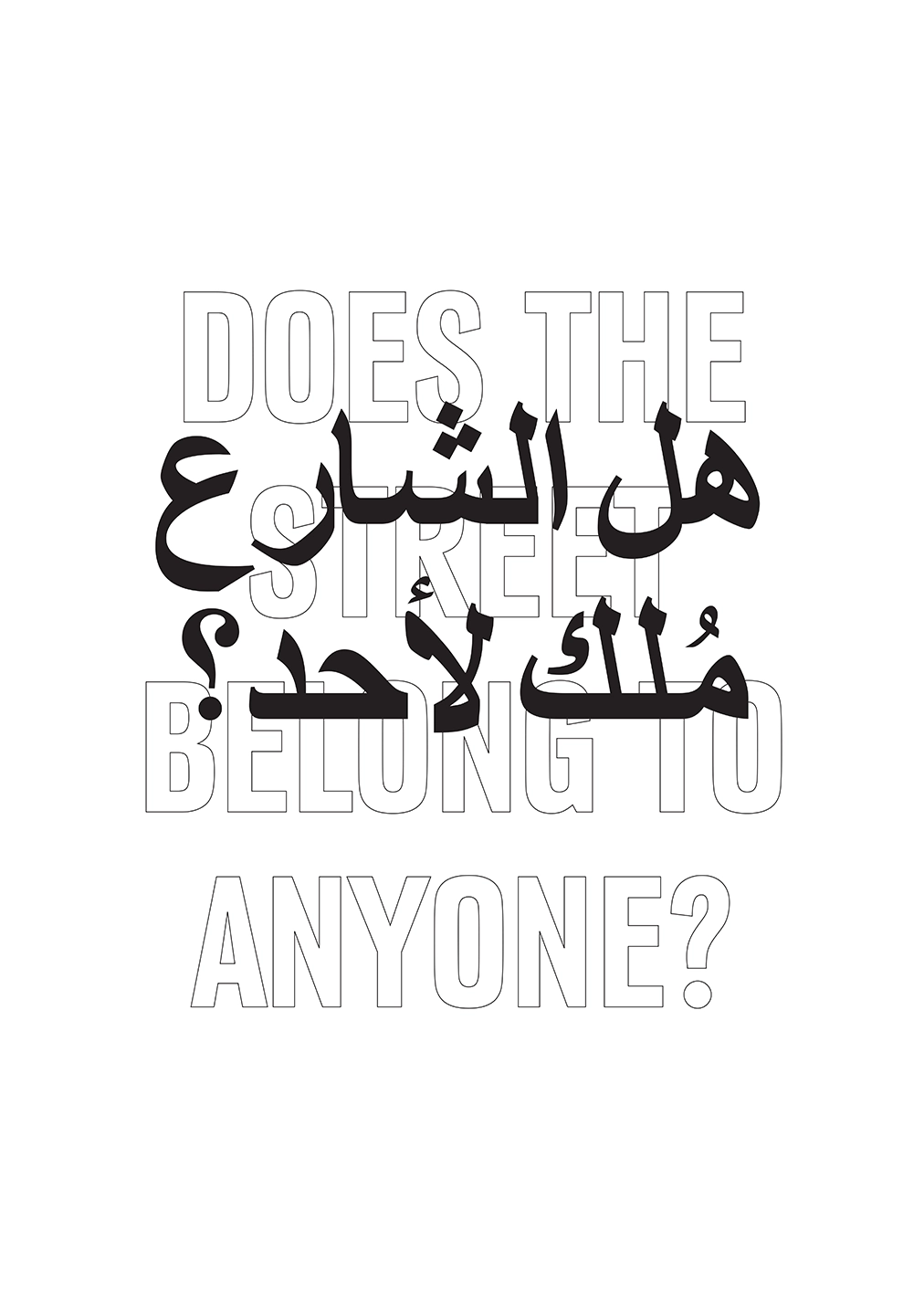
For me, the resistance and the aesthetic of the work are related and exist through the practice itself. Using a very clear and easy-to-read font, using black on white, also because of economic reasons when I print the posters, printing in big dimensions in order to be confused with the common advertisements, are choices in which there is a coincidence between the aesthetic and the political.
Your work often happens outside traditional institutions. What draws you to public space?
I have always had the feeling that reality is stronger than fiction. For this reason, I always tried to work with it, in observation and in conversation. Out of the black box, directly immersed in the complexity of the outside, into the spontaneity of the present with as little control as possible. The desire is to question certain dynamics and to use my privilege as “artist” (a category that is really problematic, much more at this point when art institutions are clearly Zionist and compromised with the Palestinian genocide) to make them visible. I do create devices through which the audience itself—the casual one and the one that comes through an invitation—can get in touch, through the device itself (like the posting public lecture), with different voices and contexts. The suggestion is given, the dramaturgy is simple, the “audience” is free to build their own narration, also starting from their own political experience. And when I say political, I mean it, starting from the awareness that everybody is political.
How do you construct performances that don’t require a stage or a script?
I do have a stage and a script, just not the ordinary one.
My stage is the billboard when I post outside, or the public toilet when we perform there.
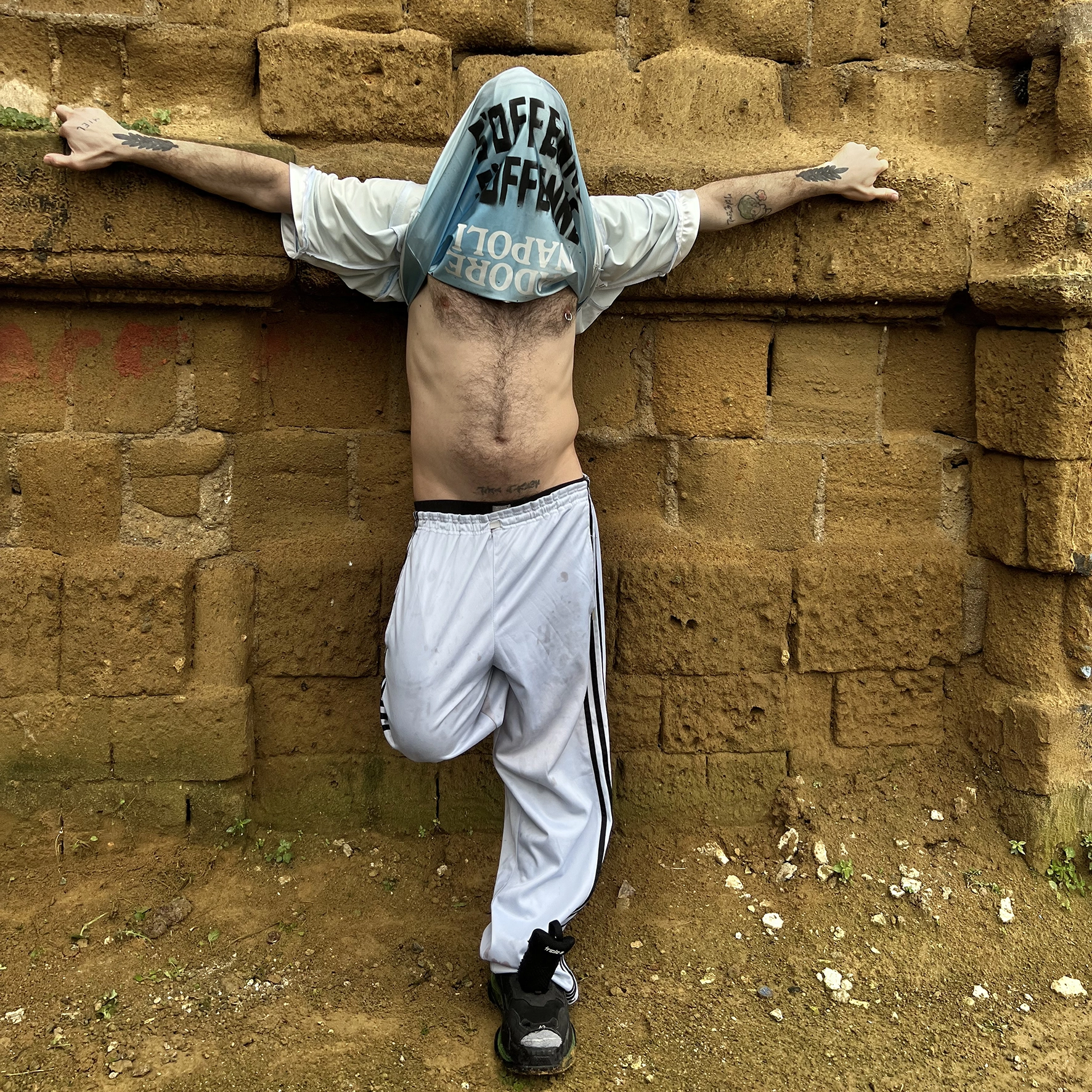
About the script, all the text I use is edited and I do know where and when I’ll go to put them outside. Even when they are printed on clothes, we tried for a long time questioning what, when, and how to get out with these words, how to give them centrality in conversation with our bodies, what if they appear before or after something else. We wonder which rhythm we should have for each text we show, and how to use it to open the gaze of the audience to the reality around us. We also question what the audience would need and how we can care about their presence, in order to create a relation that makes the passage of intentions and desires possible.
How do you use text as a performative act?
I do use it in many different ways; sometimes I do open conversation with different communities of people. The research called “The school has reopened after a snowfall,” that I did with Maddalena Fragnito, is a visual self-investigation project carried out with students from several Italian schools during and after the pandemic. A series of meetings held in schools to talk about what has happened in recent years in terms of the (partially) denied right to education; the absence of physical presence and social interaction, the witch hunt, loneliness, fear, domestication, and digital devices. But also dreams, unexpected transformations, and collective survival strategies. In this case, the text has been spread and posted with the students in the public space as much as possible, with or without authorization, creating a collective action that was liberating the content that came from the students themselves.
At the same time, I’m exploring a format called “public lecture,” where the act of gluing posters on the wall becomes a form of material slideshow. Every time, the texts are fragmented and revisited in an act of artistic editing. The wild posting’s body of works proposes a form of public literature that breaks the exposition and resolution of progressive narratives: each poster constitutes a solitary element that subverts formalism and conducts to unresolved plots of visual inquiry.
Do you consider your practice a form of social choreography?
Yes, I do. I like that the choreography is simple to get and repeat itself, but it’s empowered by the presence of reality and their horrific, unpredictable, and political dynamics.